
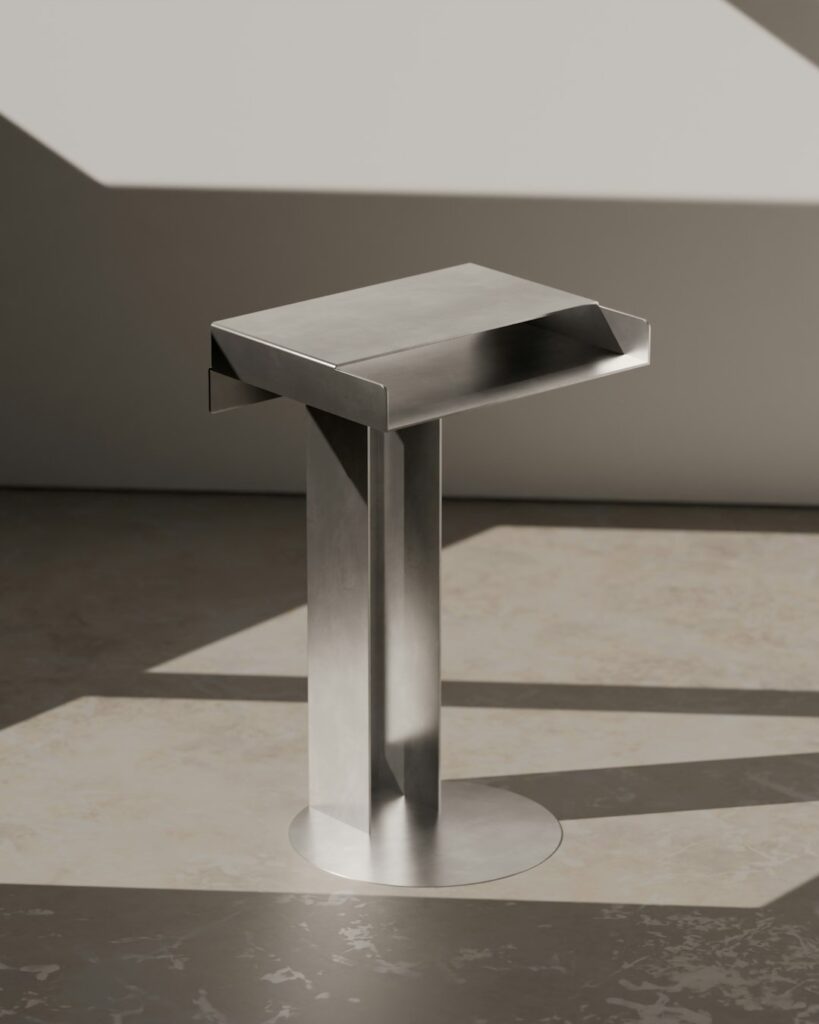
The most expensive furniture in the world has one thing in common with the best furniture made in Uganda: it does not pretend to be something it is not.
There is a category of furniture sold all over the world — in big-box stores, in online catalogues, in hotel lobbies — that is built on dishonesty. Particle board wrapped in a thin veneer of real wood. Plastic joints dressed to look like metal. Chrome-plated surfaces that will be rust in three years. This furniture is not cheap because it is made for a low market. It is cheap because it was designed to look like something it is not, and the deception is the cost saving.
At Generosity Metal Innovators, we build from the opposite principle. Every piece we make is exactly what it appears to be — and that material honesty is, in our view, what separates furniture worth owning from furniture worth discarding.
What Material Honesty Actually Means
Material honesty in furniture design is simple: the structure you see is the structure that holds the piece together. If a table appears to be supported by steel cable under tension, it is. If a shelf appears to be cantilevered from a single wall-mounted bracket, it is. Nothing is decorative that is also structural. Nothing structural is hidden behind a decorative layer.
This principle comes from the modernist design tradition — from architects like Mies van der Rohe and manufacturers like Knoll — but it is also, quietly, the tradition of every skilled artisan who ever worked in metal, wood, or stone. A blacksmith does not plate iron over plastic. A stonemason does not glue foam over concrete. The material is the design.
“The material is the design. The weld is not decoration — it is the reason the piece stands. When it is done well, it earns the right to be seen.”
Steel as a Luxury Material
Steel is not typically described as a luxury material. That word tends to be reserved for marble, solid hardwood, hand-woven textiles, and hand-blown glass. But consider what steel actually offers when it is worked by someone who knows what they are doing:
- Structural integrity across decades — a well-welded steel joint, properly finished, will outlast the building it sits in
- Infinite custom formability — steel can be bent, cut, rolled, and joined into shapes that no other structural material can achieve at the same scale
- Surface variety — from mirror-polished to raw brushed, from matte black powder coat to hot rust patina, the surface of steel is a design decision in itself
- Weight and presence — a steel piece occupies a room with authority that flat-pack furniture simply cannot replicate
- Repairability — a scratched powder coat can be recoated; a rusted joint can be cleaned and refinished; a bent frame can be straightened. Steel does not become waste easily.
The reason steel furniture is not always perceived as luxury is not the material — it is the execution. Mass-produced steel furniture is stamped, welded by robot in seconds, and finished with a spray coat that chips within a year. The material is the same. The craft is not.
How We Work at GMI
Every piece that leaves our workshop in Buloba has been cut by hand, welded by a certified welder, and finished by someone who has looked at it close enough to see every millimetre. We grind our welds flat because we want them invisible when the piece is in a room — but we also leave certain welds visible on pieces where the joint is itself a design element. We make that decision per piece, not by default.
Our powder coating is done at a facility in Kampala that we have vetted for consistency — the coat thickness, the cure temperature, the adhesion test. We do not use spray-can finishes on pieces we intend to last. We specify the finish as part of the design, not as an afterthought.
The Pieces We Are Most Proud Of
The pieces we return to most often in our own portfolio are the ones where the material is completely in charge. A tensegrity table where every cable is visible and taut. A wall sculpture where the shadow cast by the steel is as important as the steel itself. A hall stand where the weld at every joint is tight and clean enough that it reads as a detail, not a construction mark.
These are not complicated pieces conceptually. They are demanding pieces technically. The gap between a piece that looks right and a piece that is right is where the craft lives.
What This Means for You as a Buyer
If you are buying furniture for a home, a hotel, an office, or a commercial space — in Uganda or anywhere else — the most useful question you can ask a fabricator is: show me the joint. Show me how the top connects to the base. Show me what is inside the tube. Show me the weld in natural light.
Honest furniture will pass that test every time. Dishonest furniture will redirect the conversation to the finish, the colour, the delivery time. Good craft has nothing to hide.
All GMI commissions can be viewed in process at our Buloba workshop by appointment. We consider that transparency to be part of the product.
Commission a Piece
Every GMI piece is built to your specification from honest materials. We work with clients in Uganda and internationally. Lead time is 12–18 working days from deposit confirmation.

Leave a Reply